Showing posts with label automation. Show all posts

Tuesday

How to Install and Maintain Photoeye Sensors for In-bay Automatic Car Washes

http://www.pantron.com/us/applications-carwash.html
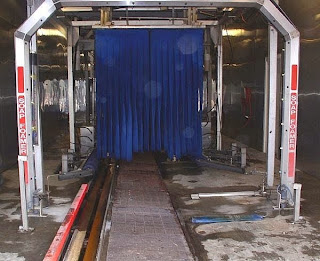
In-bay automatic car washes rely on sensors to control the car wash equipment. Without sensors, the wash computer would assume that every vehicle is the same length, height, and width. Applications for sensors include starting the wash, measuring vehicles, and controlling the opening and closing of doors. Photoelectric sensors have become a preferred method of detection due to their performance and ease of use. Proper installation and regular maintenance will ensure uninterrupted performance from the photoelectric sensors.

The first thing to consider when choosing a sensor for an automatic car wash is the type of application that the sensor will be used in. Photoelectric sensor systems typically consist of, at very least, an infrared transmitter, an infrared receiver, and in high-powered systems, an external amplifier. For the simple detection of a vehicle, the photo eyes are positioned on either side of the car wash. The transmitter photo eye emits an infrared beam of light across the bay that is detected by the receiver photo eye. When the infrared beam is interrupted by a vehicle, a signal is sent to the equipment to perform the desired application. This may be starting the equipment, measuring or profiling the vehicle, or simply opening and closing the doors. Usually, one sensor is mounted high, while the other is mounted low so that the sensors form a diagonal line to the ground. This causes the beam to pass through the area where the largest portion of the vehicle will pass and helps to reduce false signals. Mechanical treadle plates that are used to position the vehicle may be replaced by photoelectric sensing systems.
http://www.pantron.com/us/pantron-photoeyes.html
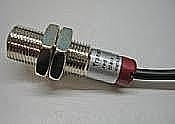
The body of the sensor should be durable and designed to withstand the harsh conditions of the wash. There are sensor bodies available in plastic, nickel-plated brass, and stainless-steel to meet the requirements of the car wash environment. A simple infrared sensor like the ones used in a residential garage door application are not designed to withstand the conditions in a car wash and should be avoided in this type of application because they lack the proper sealing. For the car wash environment select a sensor with an IP67 rating. This rating is used to inform the end-user that the sensor is sealed in a way that will not allow the internal circuits to be damaged by water spray or submersion. The range of the sensor is important for two reasons. It is much easier to mount the sensors in a place where they will not be hit if they have a long enough sensing distance. A strong infrared beam will also assist in penetrating the steam, mist, and soap that are present while the wash is running and will provide fewer false signals and the resulting down-time.

Required maintenance to photoelectric sensors is easy, and requires very little time. Check the alignment of the photo eyes using a length of string or wire long enough to pull in a line between the sensors. This line should be parallel with the sides of both sensors. If you are using a set of photoelectric sensors that uses an external amplifier, periodically check to be sure that the seal on the enclosure box is still intact and that no water has penetrated into the inside of the box.

If you have problems with the photoelectric controls, determine the nature of the problem. Are they giving an intermittent output that flickers? Do the sensors report an output all the time? Is it impossible to break the beam between the photo eyes? Once you determine the nature of the problem, it is then easier to isolate the cause. If there is a flickering output, check the alignment of the photo eyes. Next check to be sure the photoelectric system is turned high enough. (On amplified systems, this setting is located on the amplifier, inside the water-tight enclosure.) If both of these things appear normal, check for corrosion at any points where the cable has been cut and spliced. If you find corrosion, be sure to cut and reconnect the wires using a soldered connection and heat-shrink tubing. This will help seal out moisture from the connection. If you still see flickering from the output of the photo eyes, check to be sure all wires that should be grounded are connected to ground. The wires from the photoelectric controls should not share the same conduit as the wires from any motor controls.

If a constant output is the problem, check both photo eyes for obstructions. Be sure trash hasn't blown in front of the eyes and found a permanent home in the path of the beam. Alignment may also be an issue, but if they are out of alignment far enough to give a solid output signal, then this should be fairly obvious to the naked eye. Next, look closely at the face of the photo eyes. Check for visible cracks or bad abrasions. Even an IP67 sealed photo eye can be rendered useless if a large enough crack forms in the face of the sensor, thereby allowing moisture to breach the internal circuits of the photo eyes.

If it appears that the infrared beam between the eyes is impossible to break, the cause is one of several things. The first is simply that the intensity of the infrared beam is too strong and that it is literally not being blocked as the vehicle passes. Reflections on the wet walls contribute to this problem also. Try turning the strength of the system down a little. If this doesn't work, check the alignment of the photo eyes. Maybe the photo eyes see each other at an angle and when the vehicle passes through, the beam is not being broken at that angle.


Related products and information
Infrared photoelectric sensors for car washes
Infrared photoelectric amplifier for use with photoelectric sensors

Friday

How to Use Sensors to Detect that Contents are Missing from Foil Wrappers

http://www.pantron.com/us/pantron-complete-set.html
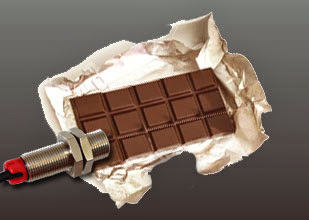
An application to detect if the contents of a foil wrapper are missing is fairly easy to solve using two sets of industrial grade high-powered infrared photoelectric sensors.

Many industries use foil wrappers to package products. For quality control, it is a good idea to have a system capable of automatically detecting when the contents of those wrappers are missing. Some companies use human beings to manually pick and choose wrappers, which is tedious, and not very efficient. There is a solution that really works; infrared photoelectric sensors.

Position one set of infrared photoelectric sensors in a through-beam configuration, so that the foil wrapper will move between the sensors at a given point. Adjust the sensitivity of the infrared photoelectric sensors so that they will detect the foil wrapper whether it is full or empty. The sensors should be at their most sensitive setting for this. The output from this set of sensors will report to the PLC to let it know when a foil wrapper is present.

Position the second set of infrared photoelectric sensors beside the first set, also in a through-beam configuration and facing the same direction. Be sure that the sensors are set to different frequencies to avoid cross-talk between the two sets. This set of sensors should be adjusted to its least sensitive setting. In other words, crank the gain setting to the max. Assuming that the photoelectric sensors being used are industrial grade, they should be able to see through an empty wrapper easily, but not one containing product. This set should also report to the PLC.

Now, you have two infrared beams of light striking the foil wrapper as it passed. One is used as a reference to let the PLC know when a foil wrapper is present. The second set of sensors lets the PLC know when a foil wrapper is missing its expected contents. This system is very reliable and is in use at a number of companies worldwide.


Related products and information
Stainless-steel infrared photoelectric sensors for packaging applications