If you are replacing a 3 wire sensor which operates on DC voltage, it is important to know whether the sensor's output is a PNP or NPN type. Often this information is printed on the sensor itself, but it is not uncommon for it to be scratched off over a long period of time.
Set the multi meter to DC voltage. This is indicated by either the letters "VDC" or "DCV" or by a symbol which looks like 3 dashed lines over a solid line. There are usually several levels within the DC voltage setting. Choose the "600" level.
The power will need to be ON to perform this test, so use caution when attempting the following. Connect two of the sensor wires to the power supply. If the color combination of the wires is blue, black, and brown, then normally, the blue wire connects to 0v and the brown wire connects to positive volts. Touch the black meter probe to the 0V wire of the sensor. Connect the red meter probe to the signal output wire of the sensor. This wire is normally black. The meter should read "0."
Force the sensor to output. If it is a photoelectric sensor, block the photoelectric beam. If it is an inductive proximity switch, introduce a small piece of metal in front of the sensor. For an ultrasonic sensor or a capacitive sensor, you can just use your hand to make the sensor output. Be sure that the sensor is detecting the object. Many sensors have a small LED that illuminates when the sensor detects it's target.
Watch the meter display as you force the sensor to output. If the readout changes to a number between 10 and 30, then the sensor output is a PNP type, also known as "sourcing." If the meter display remains at "0", then the sensor output is an NPN type, also known as "sinking."
If you believe that the sensor is NPN, there is an additional test that may be done to confirm. Remove the meter probes from the wires. Now place the red meter probe on the positive voltage sensor wire, normally a brown wire. Touch the black meter probe to the signal output wire of the sensor, normally black. When the sensor does not detect it's target, the meter display should read between 10 and 30. When the sensor senses an object, the display should drop to "0." This will confirm that the sensor has an NPN type output.
Showing posts with label electric. Show all posts
Wednesday
Friday
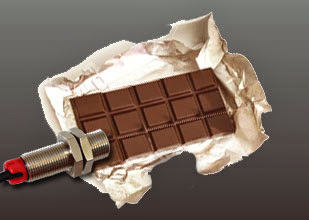
How to Use Sensors to Detect that Contents are Missing from Foil Wrappers
An application to detect if the contents of a foil wrapper are missing is fairly easy to solve using two sets of industrial grade high-powered infrared photoelectric sensors.
Many industries use foil wrappers to package products. For quality control, it is a good idea to have a system capable of automatically detecting when the contents of those wrappers are missing. Some companies use human beings to manually pick and choose wrappers, which is tedious, and not very efficient. There is a solution that really works; infrared photoelectric sensors.
Position one set of infrared photoelectric sensors in a through-beam configuration, so that the foil wrapper will move between the sensors at a given point. Adjust the sensitivity of the infrared photoelectric sensors so that they will detect the foil wrapper whether it is full or empty. The sensors should be at their most sensitive setting for this. The output from this set of sensors will report to the PLC to let it know when a foil wrapper is present.
Position the second set of infrared photoelectric sensors beside the first set, also in a through-beam configuration and facing the same direction. Be sure that the sensors are set to different frequencies to avoid cross-talk between the two sets. This set of sensors should be adjusted to its least sensitive setting. In other words, crank the gain setting to the max. Assuming that the photoelectric sensors being used are industrial grade, they should be able to see through an empty wrapper easily, but not one containing product. This set should also report to the PLC.
Now, you have two infrared beams of light striking the foil wrapper as it passed. One is used as a reference to let the PLC know when a foil wrapper is present. The second set of sensors lets the PLC know when a foil wrapper is missing its expected contents. This system is very reliable and is in use at a number of companies worldwide.
Related products and information
Stainless-steel infrared photoelectric sensors for packaging applications
Many industries use foil wrappers to package products. For quality control, it is a good idea to have a system capable of automatically detecting when the contents of those wrappers are missing. Some companies use human beings to manually pick and choose wrappers, which is tedious, and not very efficient. There is a solution that really works; infrared photoelectric sensors.
Position one set of infrared photoelectric sensors in a through-beam configuration, so that the foil wrapper will move between the sensors at a given point. Adjust the sensitivity of the infrared photoelectric sensors so that they will detect the foil wrapper whether it is full or empty. The sensors should be at their most sensitive setting for this. The output from this set of sensors will report to the PLC to let it know when a foil wrapper is present.
Position the second set of infrared photoelectric sensors beside the first set, also in a through-beam configuration and facing the same direction. Be sure that the sensors are set to different frequencies to avoid cross-talk between the two sets. This set of sensors should be adjusted to its least sensitive setting. In other words, crank the gain setting to the max. Assuming that the photoelectric sensors being used are industrial grade, they should be able to see through an empty wrapper easily, but not one containing product. This set should also report to the PLC.
Now, you have two infrared beams of light striking the foil wrapper as it passed. One is used as a reference to let the PLC know when a foil wrapper is present. The second set of sensors lets the PLC know when a foil wrapper is missing its expected contents. This system is very reliable and is in use at a number of companies worldwide.
Related products and information
Stainless-steel infrared photoelectric sensors for packaging applications
Labels:
automation,
contents,
detect,
electric,
electronic,
foil,
infrared,
missing,
photoelectric,
photoeye,
sense,
Sensor,
wrapper
Subscribe to:
Posts (Atom)